The EV-Canola Deal is an Economic Reset Saskatchewan Needed
January 30, 2026
The EV-Canola Deal Is an Economic Reset Saskatchewan Needed
Canada’s new trade agreement with China – covering canola and electric vehicles – marks a meaningful economic reset. For Saskatchewan, and for Regina in particular, the implications are significant and largely positive.
At the centre of the deal is canola. China has agreed to cut tariffs on Canadian canola seed from roughly 84% to about 15%, while also removing additional penalties on canola oil and meal that had effectively shut Canadian producers out of the market. In return, Canada will allow up to 49,000 Chinese-made electric vehicles into the country annually at the standard 6.1% tariff, rather than the previously proposed 100% rate.
While the EV component has attracted headlines, the canola side of the agreement is what truly matters for Saskatchewan.
Reopening a Critical Market
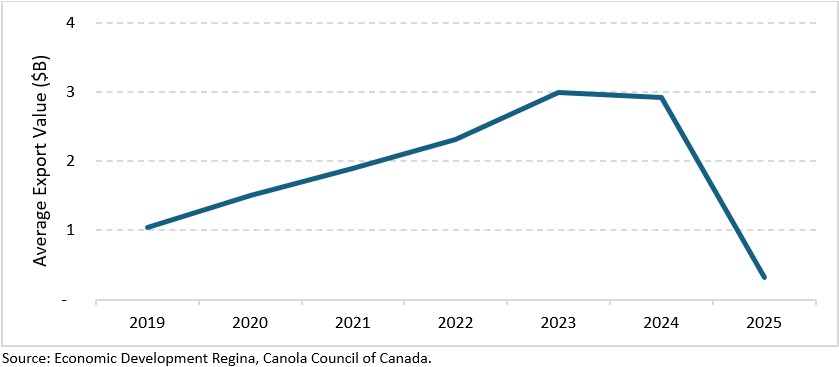
China has long been one of Canada’s most important buyers of canola seed, oil, and meal. Saskatchewan typically accounts for about 54% of that trade. In dollar terms, the province’s exports to China grew from roughly $1B in 2019 to about $3B in 2023.
That momentum came to a sudden halt.
As tariffs rose and trade uncertainty deepened, Saskatchewan’s canola exports to China dipped in 2024 and then collapsed to approximately $324M by October 2025. In just one year, billions of dollars in economic activity disappeared – impacting farmers, crushers, grain handlers, and rail-linked communities across the Prairies.
The new agreement offers a clear path back.
Even if export volumes take time to fully recover, restored market access combined with relatively strong canola prices could allow Saskatchewan to regain a significant share of that lost income. That translates into higher farm cash receipts, renewed investment in equipment and storage, and stronger demand for rural and regional services.
What It Means for Regina
As Saskatchewan’s commercial and administrative hub, Regina is well positioned to feel the rebound.
Increased canola exports mean more grain moving through the supply chain – by truck and by rail. That activity supports transport and logistics companies, warehouses, maintenance shops, and equipment dealers, many of which are based in or operate out of Regina.
Financial institutions, insurers, and professional service firms in the city also stand to benefit. As producers and grain companies scale back up, demand will grow for financing, risk management, legal, and accounting services. At the same time, Regina’s role as the provincial capital means greater involvement in infrastructure planning, policy development, and trade-related coordination as the sector rebounds.
The EV Angle: A Secondary but Growing Opportunity
The electric vehicle component of the agreement is more indirect for Regina, but still relevant. Increased availability of Chinese EVs could accelerate adoption over time, supporting growth in charging infrastructure, automotive services, and utility planning.
That said, Regina’s most immediate gains will come through familiar channels: grain, rail, and finance – long-standing pillars of the local economy that are once again aligned with one of the world’s largest markets.
Why This Matters
Canola remains one of Saskatchewan’s most powerful economic drivers.
- Annual economic activity linked to canola: $23.6 billion
- Jobs supported by the canola sector: 100,000+
This agreement doesn’t solve every challenge facing the agri-food sector, but it restores something essential: access. For Saskatchewan and Regina, that access brings stability, confidence, and renewed opportunity – exactly what’s needed in an increasingly uncertain global trade environment.
Figure 1: Average Value of Saskatchewan Canola Exports to China (2019-20252)